Sprinkler water damage almost always traces back to a system that was not inspected, protected or kept in working order, not to a sprinkler that “went off on its own.” Fire sprinkler heads are designed to open only in response to heat, so discharges that were not caused by a fire usually come from overheating near a head, impact, corrosion, freezing, closed or faulty valves, or installation and construction errors. Each of these can be found and corrected during scheduled inspections. For property managers, industrial operators and municipalities in Grande Prairie, Dawson Creek and the Peace Region, the practical answer is a documented inspection routine carried out by a qualified sprinkler fitter, which is what our sprinkler inspection service provides.
TL;DR
- Sprinklers cause far less water damage than a fire does: a typical head discharges about 55 litres per minute, while a firefighting hose discharges over 600 litres per minute (BAFSA).
- Accidental discharges are mostly preventable. Recognised causes include overheating, impact, corrosion, freezing, improper installation, construction damage and vandalism (Ecclesiastical Insurance).
- Water supply problems, such as closed valves, corroded pipe and poor water quality, reduce flow and pressure and can leave a system unable to perform when it is needed.
- Regular inspection, testing and recordkeeping by qualified personnel is the control that addresses both leaks and supply failures.
- After a discharge, the order of work is: make the area safe, stop the flow with a qualified person, document everything, then repair and restore the system.
Table of Contents
- How much damage do sprinklers actually cause?
- What causes sprinkler leaks and accidental discharges
- Sprinkler water supply issues
- What inspection and maintenance prevent both problems
- Why a site-specific assessment comes first
- What to do when a sprinkler releases water
- Records, insurance and the cost of deferral
- How FourPoint helps
- FAQ
- Sources
How much damage do sprinklers actually cause?
The common assumption is that a sprinkler discharge ruins a building as badly as a fire would. The flow rates say otherwise. A typical sprinkler discharges about 55 litres per minute, and a firefighting hose discharges more than 600 litres per minute, according to the British Automatic Fire Sprinkler Association. Only the heads near the fire open, so the water is applied where it is needed and early, before the fire grows.
Reliability is the other half of the picture. A National Research Council of Canada building digest on sprinkler reliability reports satisfactory performance in 96% to 99% of fire occurrences, and it names inadequate maintenance and antiquated equipment as the preventable causes of the failures that do occur. The digest dates from 1985, so treat the percentages as a historical benchmark. The conclusion still holds: the system works when it is kept in condition, and most of what goes wrong is within the owner’s control.
This matters for how you budget. A planned inspection and repair programme costs less than a flooded floor, a failed system during a fire, or a claim complicated by known but unaddressed deficiencies.
What causes sprinkler leaks and accidental discharges
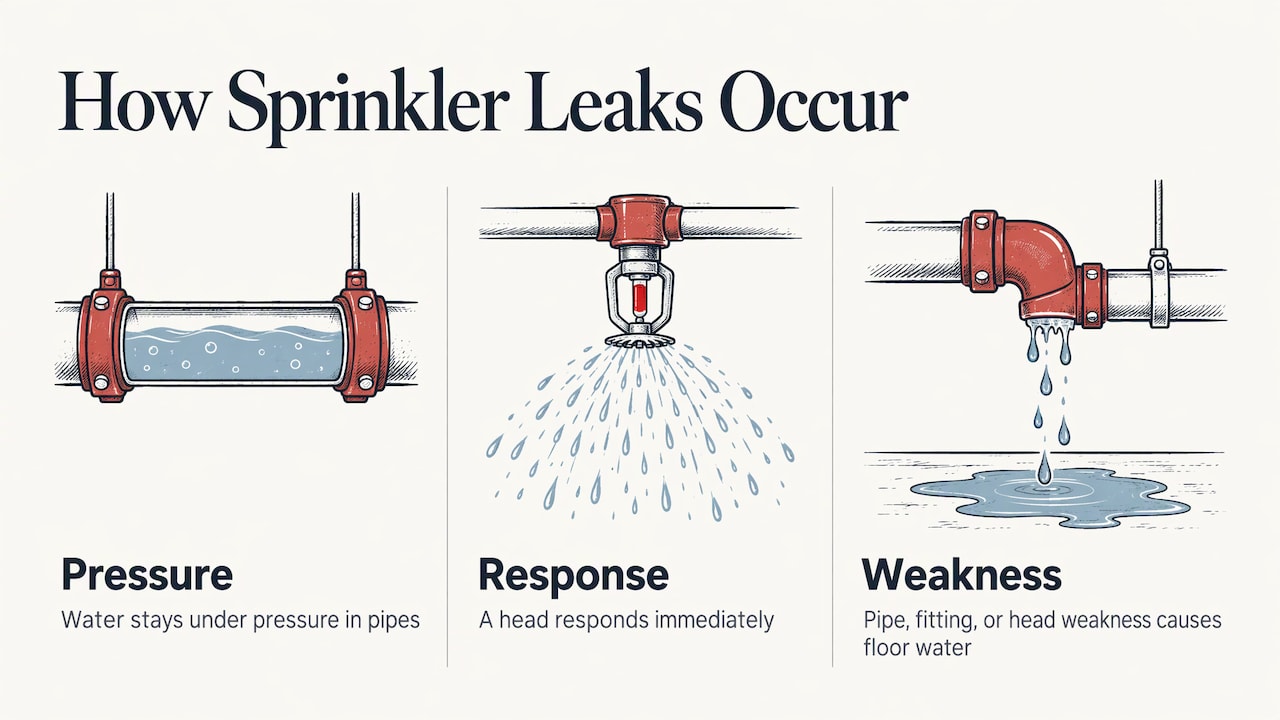
A wet sprinkler system holds water under pressure in the pipes at all times. That is what allows a head to respond immediately, and it is also why any weakness in the pipe, fitting or head shows up as water on the floor. Ecclesiastical Insurance’s Canadian guidance on avoiding freeze-ups and malfunctions lists the causes, and manufacturing defects are rare among them. The causes you are most likely to meet are below.
Overheating near a head
Each head has a heat-sensitive element rated for a specific temperature. A head mounted close to a unit heater, a kitchen exhaust, a boiler room flue or stored product that gives off heat can reach its activation temperature without any fire. The fix is usually a change of head rating or relocation of the heat source, and it is identified during a walk-through, not after a discharge.
Impact and mechanical damage
Forklifts, ladders, pallet racking, signage and maintenance work can strike a head or a pipe. Heads in warehouses, shops and parking structures are the most exposed. Guards on vulnerable heads and a rule that nothing is stored or hung from sprinkler piping address the risk directly. The Ontario Fire Code requires sprinkler heads to be protected from mechanical damage (Section 6.5). It is an Ontario regulation, but it describes good practice for any property, and Alberta and British Columbia owners should confirm the rules that apply to them with their authority having jurisdiction.
Freezing
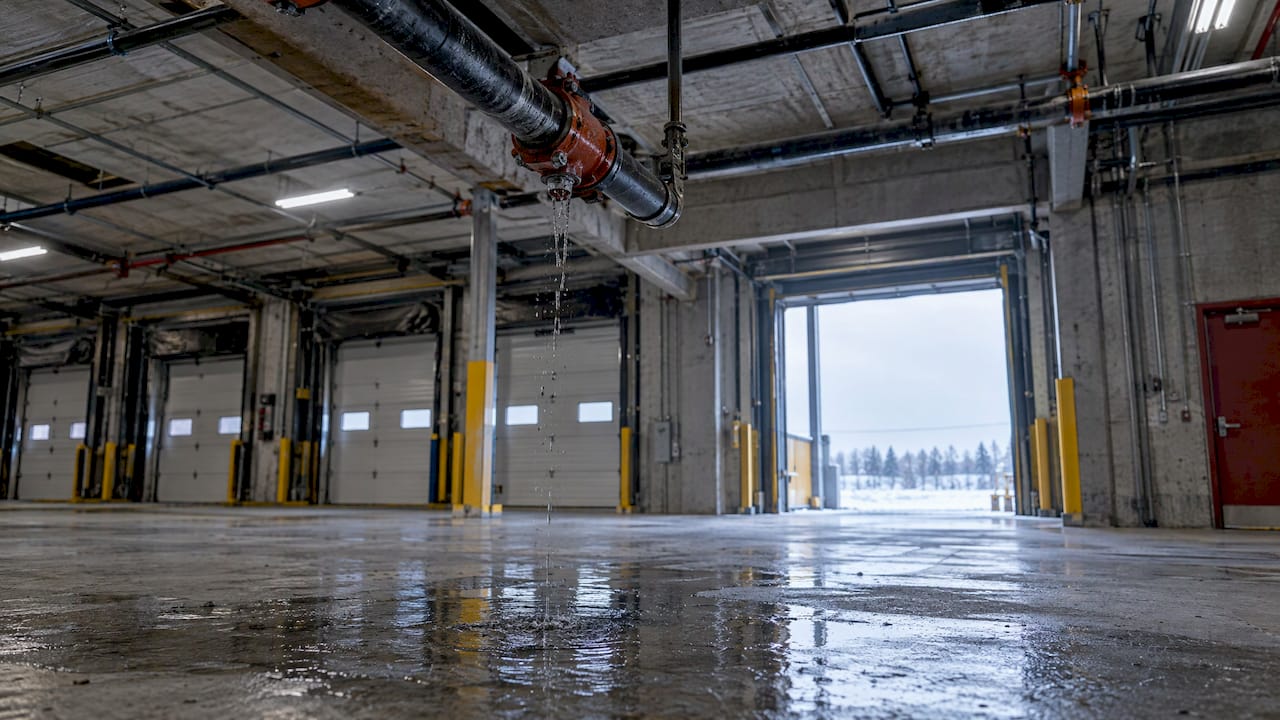
In the Peace Region, freezing is the cause most owners should plan for. Water in a pipe that runs through an unheated void, a loading dock, a vestibule or an attic expands as it freezes and can split the pipe or fitting. The leak then appears at thaw, when the water flows again. Ecclesiastical’s guidance advises keeping the control valve set and fire pump above 4°C, protecting exposed pipework against freezing, and draining dry-pipe lines after annual testing so that water does not sit in them over winter. Walk the building before the first hard cold, and check for broken windows, open doors and failed heaters in rooms that contain sprinkler pipe.
Corrosion
Steel pipe corrodes from the inside and the outside. Over time, pitting can lead to pinhole leaks, and scale and debris can obstruct heads and restrict flow. Water quality is a factor, and so is water left standing after a system test. A trade article on microbiologically influenced corrosion reports pitting in new systems within 24 to 36 months where water is contaminated or left standing after testing, and recommends nitrogen generators in dry-pipe systems as one way to reduce it (247 Restoration Specialists). Internal inspections and flushing as required are the practical controls.
Installation and construction damage
Poorly made joints, incorrect hangers and heads damaged during tenant improvements or renovations all show up later as leaks. Renovation work also creates a second hazard: valves closed so that a section can be altered and not reopened afterward. That brings us to the water supply.
Vandalism
Deliberate damage to exposed heads is a recognised cause in the same guidance. Guards and good sight lines in stairwells, parkades and vacant units reduce it.
Sprinkler water supply issues
A sprinkler system that does not leak can still fail the other way: it opens at a fire and receives too little water. A Facilities Net article on valve problems and water quality identifies three recurring causes of reduced flow or pressure: closed valves, degraded or corroded pipes, and poor water quality. System failures have followed valves closed during renovation or repairs and never reopened.
The warning signs an owner or manager can see without opening anything include:
- A supply or alarm valve that is not sealed or locked open, or has no tag recording who closed it.
- A pressure gauge that reads differently from its normal value, or has been left unreadable.
- Discoloured or debris-laden water at a main drain test.
- Heads with visible corrosion, paint, or buildup on them.
- Piping or hangers that are sagging, rusted or have been modified by another trade.
Any one of these is a reason to arrange a service visit. Water supply problems that originate outside the building, such as a weak municipal main or a private underground service line, need to be assessed together with the sprinkler riser, and our underground repairs and standpipe work are part of the same assessment on properties where they apply.
What inspection and maintenance prevent both problems
The benchmark for inspection, testing and maintenance of water-based fire protection systems is NFPA 25, which sets the level of maintenance and the frequency of testing, as Ecclesiastical’s guidance notes. Which edition and which provincial requirements apply depends on the property, the local fire code and the authority having jurisdiction, so confirm that before you set your schedule.
The Ontario Fire Code, Section 6.5, is a useful published example of how frequent the routine is. These are Ontario’s requirements, not Alberta’s, and they are shown here as a reference for the kind of schedule a system needs:
| Interval | Task (Ontario Fire Code s. 6.5) |
|---|---|
| Weekly | Check water-supply pressure and system air or water pressure on gauges; inspect supply and alarm valves that are sealed open |
| Monthly | Inspect valves that are locked open or electrically supervised; test alarms |
| Every three months | Inspect priming water in dry-pipe systems |
| Annually | Inspect heads and exposed hangers; test wet-system water-flow alarms, main drains and dry-pipe valves |
| Every three years | Test dry-pipe valves with the control valve fully open |
The code also expects spare heads to be kept on site, valves to be accessible and operable, and heads to be protected from mechanical damage.
Municipal practice shows the same pattern. The Town of Georgina’s 2025 maintenance record calls for weekly checks that non-electrically supervised water-supply and alarm valves are sealed or locked open and that dry-pipe air gauges hold the required pressure. It also lists quarterly inspection of dry-system priming water and six-monthly testing of supervisory devices.
What Dawson Creek expects
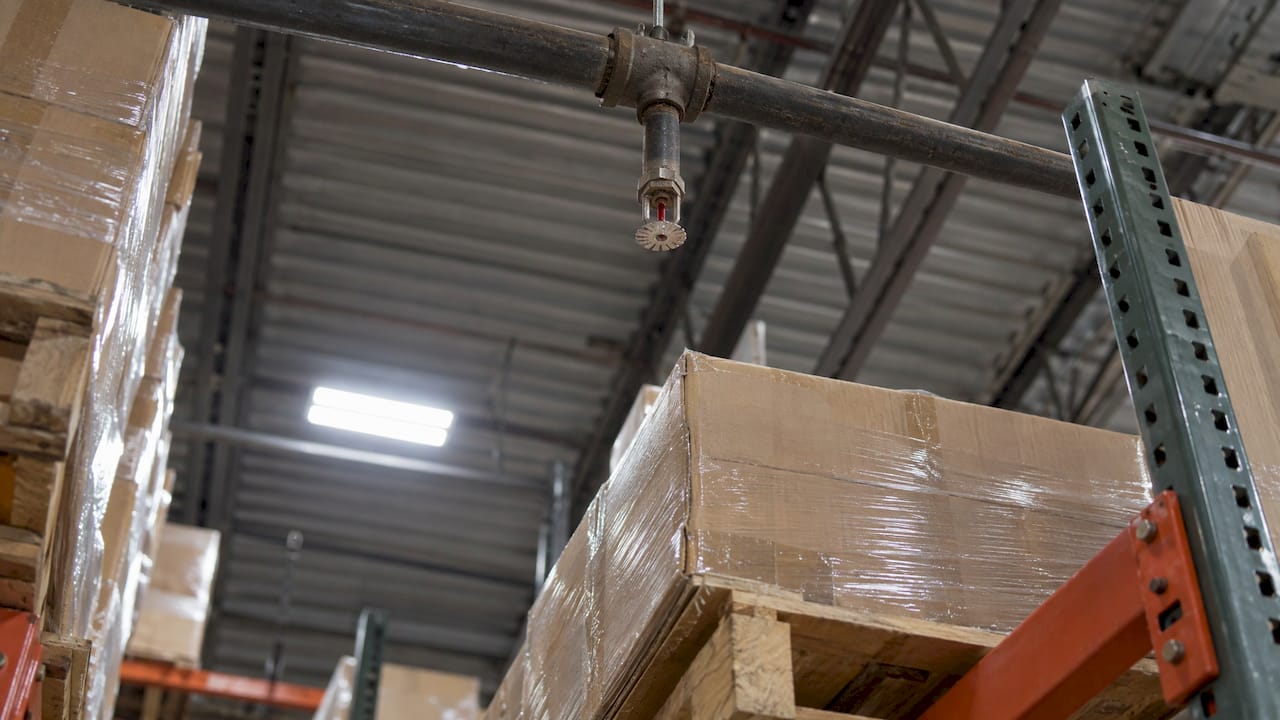
For properties in the Peace Region, the City of Dawson Creek’s 2024 fire inspection handout for assembly occupancies is a local reference. It states that sprinkler systems should be inspected and tested by qualified personnel at least annually, carry a service tag dated within the last 12 months, keep sprinkler connections capped and accessible, and maintain at least 18 inches of clearance below sprinkler heads. Storage against the clearance rule is among the most common findings in any building, and it is also one of the easiest to correct.
A checklist for in-house staff
The weekly and monthly tasks are visual and can be done by trained building staff. A record of each visit is as important as the visit.
- Confirm the supply and alarm valves are open, sealed or locked, and tagged.
- Read and log the pressure gauges, and note any change.
- Check that heads are clear of obstruction, paint and damage, with the required clearance beneath them.
- Check that connections are capped and accessible.
- Look for leaks, corrosion and wet spots at pipe joints and hangers.
- Confirm spare heads and the wrench are in the cabinet.
- Keep the heated spaces that contain sprinkler pipe above freezing, and log the check in cold weather.
- File the record where it can be shown to an inspector or insurer.
The annual and multi-year tests are different. They involve operating valves, flowing water and testing alarms, and they need qualified personnel, calibrated equipment and a report. Insurance guidance for public entities from Intact asks whether deficiencies have been corrected, whether inspection records and tags are retained, whether systems are flushed as required, whether internal obstructions and corrosion are checked, and whether the drains can handle the discharge. A report that answers each of those is the document that protects you in an inspection or a claim.
Why a site-specific assessment comes first
Two properties with the same sprinkler layout can need very different programmes. A heated office tower, an unheated warehouse with a dry-pipe system, and a municipal recreation facility with long unoccupied periods each carry different freezing, corrosion and impact risks. The generic checklist finds the obvious defects. A site assessment also asks about the operating context: how the building is used, who works near the system, what changed since the last inspection, and which valves other trades have touched.
That is how we approach it. Our work is led by a Red Seal Journeyman Sprinkler Fitter with more than two decades of experience in commercial and industrial environments. The process emphasises tailored, site-specific assessments and clear communication, so that scope, context and equipment details are settled before any work is arranged. For an owner, that means the inspection report describes your system and your building, in terms you can act on, and the repair scope matches the findings.
What to do when a sprinkler releases water
If a head has operated, first establish whether there is a fire. If there is, evacuate and call 911, and leave the system running until the fire service directs otherwise. If there is no fire, the aim is to stop the flow safely and limit what the water reaches.
- Make the area safe. Keep people away from wet electrical equipment and slippery floors. Shut off power to affected areas if you can do so safely.
- Stop the flow. Closing the system or zone control valve stops the discharge, but it also takes the system out of service. Have a qualified person do it, and notify your fire department and insurer as your policy and local rules require, so that protection is restored quickly.
- Document before cleanup. Photograph and record the damage, the head or pipe that failed, and the valve positions. Keep the failed component if you can.
- Remove standing water and contents. Move stock and furnishings out of the wet area, and begin extracting water promptly.
- Repair and restore protection. The failed head or pipe has to be replaced and the system returned to service by a qualified sprinkler fitter. Our sprinkler repairs cover this stage, and the post-repair inspection confirms the system is ready to protect the building again.
- Find the cause. A discharge is a finding. Whether it was freezing, impact, heat or corrosion decides what else in the building needs attention.
Drying matters as much as extraction. Water that enters wall cavities or insulation stays there after the surface looks dry, so moisture checking of concealed spaces is part of a proper recovery. Cost and timeline depend on how much water was released and for how long, which materials became wet, whether it reached concealed spaces, and how long insurance approval and reconstruction scope take to settle. Obtain written estimates after drying and scope are determined, because figures given before that point are guesses.
Records, insurance and the cost of deferral
Owners often treat inspection records as paperwork. They are also the evidence of a maintained system. Insurers ask whether deficiencies were corrected, whether tags are current and whether corrosion was checked, as the Intact guidance shows. A trade article reports that failing to address known corrosion can lead to higher premiums or denied claims (247 Restoration Specialists). Confirm the terms of your own policy with your broker.
A practical annual cycle for a Peace Region property looks like this:
- Late summer: book the annual inspection and testing, including main drain and alarm tests, so deficiencies can be fixed before cold weather.
- Before the first hard freeze: walk the building for heat and enclosure problems around pipe, and drain and service dry-pipe systems.
- After any renovation or tenant work: confirm every valve is open and every head is intact and unobstructed.
- After a cold snap or an impact event: inspect the affected area before it becomes a leak.
- Each year: file the report and correct every listed deficiency, then keep the service tag current.
How FourPoint helps
We inspect, repair and install fire sprinkler systems for commercial, industrial and municipal properties in Grande Prairie, Dawson Creek and the Peace Region. Our fire sprinkler inspections assess the system and its operating context, and our sprinkler system installations are available when a building is renovated or extended. Where the water supply is the question, we also service standpipe systems, backflow prevention and cross-connection control, and hydrants. Recordkeeping support for region-specific compliance is part of the work.

To arrange an assessment, start at fourpointfire.com or review the sprinkler inspection page for what a visit covers.
FAQ
Do fire sprinklers cause more water damage than a fire?
No. A typical sprinkler discharges about 55 litres per minute, compared with more than 600 litres per minute from a firefighting hose (BAFSA). Only the heads closest to the fire open, and they control the fire early, which limits both fire and water damage.
Why is a sprinkler leaking when there is no fire?
The usual causes are overheating near a head, impact, corrosion, freezing, improper installation, construction damage and vandalism, according to Ecclesiastical’s guidance. Manufacturing defects are rare. A qualified sprinkler fitter should locate the source and repair it, and the system should be tested before it is returned to service.
What causes sprinkler water supply problems?
Closed valves, degraded or corroded pipes and poor water quality can all reduce flow and pressure (Facilities Net). Valves closed during renovation and not reopened are a recurring cause. Weekly valve and gauge checks, plus annual testing, identify these problems early.
How often should a sprinkler system be inspected?
Dawson Creek’s 2024 handout says a qualified person should inspect and test sprinkler systems at least annually, with a service tag dated within the last 12 months (City of Dawson Creek). Visual checks of valves and gauges happen more often, and NFPA 25 sets the testing frequencies.
What should I do first after a sprinkler discharge?
If there is a fire, evacuate and call 911. If not, make the area safe and have a qualified person stop the flow. Then photograph the damage before cleanup, begin water removal, and arrange repair and testing of the system.
Sources
- BAFSA: Why sprinklers?
- CBD-238, The Reliability of Automatic Sprinkler Systems
- Ecclesiastical Insurance: Avoiding freeze-ups and malfunctions of automatic fire sprinkler systems
- Ontario Fire Code, Section 6.5 Sprinkler Systems
- Facilities Net: Valve problems and water quality can affect fire sprinkler functionality
- Town of Georgina: Sprinkler system maintenance record
- City of Dawson Creek: 2024 fire inspection handout, assembly occupancies
- Intact: Risk management considerations for sprinkler systems
- Microbiologically influenced corrosion in fire sprinklers