Fire backflow testing is the annual check that the backflow prevention assembly on your fire sprinkler, standpipe or private hydrant supply still stops water from flowing backward into the municipal drinking water system. In Canada the requirement comes from your local water authority and plumbing code, not from the fire code, so the frequency, the tester qualifications and the reporting rules depend on where the building is. At FourPoint Fire & Water we test, repair and document these assemblies for commercial, industrial and municipal properties in Grande Prairie, Dawson Creek and the Peace Region, and we work from the fire protection side, where the assembly, the sprinkler system and the underground piping all have to work together.
TL;DR
- A backflow assembly on a fire line protects the public water supply from stagnant, treated or contaminated water in your fire protection piping. It has internal seals and springs that wear, so it is tested, not just installed.
- Most Canadian water authorities require a test at installation, at least once a year after that, and after any cleaning, repair or replacement. Your municipality sets the exact rule.
- Tests must be done by a certified tester, and the signed report goes to the water authority and stays on site with you.
- A failed assembly must be repaired and retested. Some municipalities can suspend water service for non-compliance.
- Fire systems add a second concern: the assembly must not choke the flow your sprinklers, standpipes or hydrants need.
Table of Contents
- Why fire lines need backflow protection
- Which assemblies are used on fire systems
- What the test involves
- How often, and by whom
- If an assembly fails
- Fire hydrants and backflow
- What drives the cost
- Our perspective
- Backflow testing with FourPoint
- FAQ
- Sources
Why fire lines need backflow protection
A fire sprinkler system holds water that sits still for months or years. That water can pick up sediment, bacteria and corrosion byproducts, and in some systems it carries antifreeze or other additives. If pressure drops on the supply side, for example during a water main break or heavy hydrant use nearby, water can be drawn backward out of your piping and into the public system. That reverse flow is backflow, and the pressure-loss version is called backsiphonage. The connection between a private system and the public supply that makes it possible is a cross-connection.
Utilities treat fire protection connections as a cross-connection hazard for this reason. Columbus City Utilities explains that stagnant sprinkler-line water can be siphoned back during a pressure drop, and that annual testing is needed because internal components are subject to fouling, wear or fatigue. The Town of Trenton, Nova Scotia gives the same rationale in its cross-connection control program: seals and springs wear, so annual testing is the minimum.
Where the requirement comes from
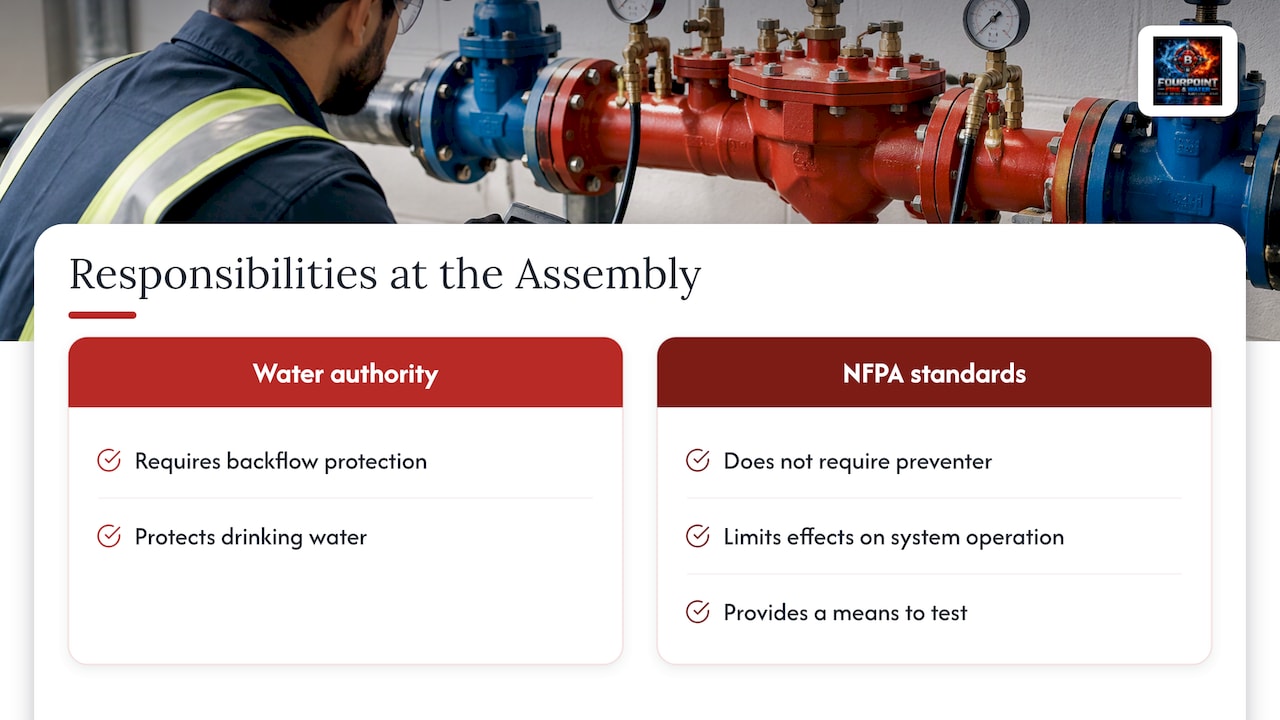
People often assume NFPA standards require the device. They do not. An NFPA technical services engineer explains that the backflow requirement for fire protection systems comes from the local water authority. NFPA 13 does not require a backflow preventer, but it adds installation requirements that limit the device’s effect on system operation and provide a means to test it.
For a property manager, the practical meaning is that two sets of rules meet at one assembly. The water authority wants proof the device protects the drinking water. The fire protection standards want proof it does not compromise the system’s ability to deliver water to a fire.
Which assemblies are used on fire systems
The type of assembly depends on the hazard level your water authority assigns to the connection and on local code.
| Assembly | What it is | Typical fire use |
|---|---|---|
| Double check valve assembly (DCVA) | Two independently acting check valves in series, with no relief valve | Sprinkler connections where the water has no chemical additives and local code permits it |
| Double check valve assembly for fire protection systems (DCVAF) | A detector-type double check assembly with a bypass line that lets the water authority see small leakage | Sprinkler and standpipe branch lines where a detection-type assembly is specified |
| Reduced pressure zone assembly (RP, RPZ) | Two check valves with a relief valve between them that discharges if pressure reverses | Higher-hazard connections, such as systems with additives |
Municipal wording varies. The City of London’s guide for backflow prevention serving fire protection systems names the DCVAF as a typical device type, requires confirmation that the assembly will not reduce fire system performance through pressure loss, and requires electrically supervised tamper and flow switches to be connected to the fire alarm control panel where a fire alarm exists. The City of St. John’s policy 08-04-18 requires sprinkler and standpipe branch lines to have a UL-listed, FM-approved detection-type backflow preventer, at minimum a DCVAF.
Those are Ontario and Newfoundland examples. For a site in the Peace Region, confirm the assembly type with your water utility before replacing or adding one.
What the test involves
A certified tester connects a differential pressure gauge kit to the assembly’s test cocks, which are small ports on the device body. The tester then checks each check valve, and on a reduced pressure assembly the relief valve, against the minimum pressure differentials the local program sets. A pass means every component meets its minimum. A failure on any single component means the assembly fails and needs repair and a retest. The City of Toronto’s program, for example, reports results on a standard online test form completed by a certified specialist.
On fire lines, the water-quality test is not the only check. The Fire Technicians Network Professional Practice Manual states that the forward flow test is performed annually as NFPA 25 requires, to verify the rated flow through piping served by a backflow preventer. It is always followed by the performance test the local water authority requires, and if the forward flow test cannot be performed, the tag must read “Additional Work Required”. A tester who understands sprinkler systems matters here, because a forward flow test involves opening the fire system’s water path, not only reading gauges.
What to prepare before test day
- Locate every assembly on the property, including those in underground vaults, mechanical rooms and at private hydrant branch connections.
- Confirm access: the tester needs clear room around the device and its test cocks, and a vault must be safe to enter.
- Notify your alarm monitoring company, because closing valves can trigger tamper or supervisory signals.
- Tell building staff that the fire system will be briefly isolated or flowing, so water discharge at drains is not mistaken for a leak.
- Pull last year’s test report so the tester can compare readings and see any recurring problem.
We take this planning off your hands when we test an assembly: we identify the equipment, confirm what is installed and set the scope with you before any work is arranged.
How often, and by whom
The pattern across Canadian municipalities is consistent, even where details differ:
- At installation: the Technical Safety Authority of Saskatchewan notes that the National Plumbing Code requires testing on initial installation, with local bylaws or other agencies setting any further frequency.
- Annually: Toronto requires testing at installation, within 72 hours after cleaning, repair, replacement, servicing or overhaul, and at least once a year. Guelph applies annual testing to irrigation and fire sprinkler systems, and Waterloo requires annual testing and testing after cleaning, repair, overhaul or relocation.
- Reporting windows: Waterloo and Guelph both set 14 days for submitting reports, while Trenton sets 10 days for annual results. Your municipality’s window may be different.
- Record keeping: Waterloo requires reports to be kept on site for at least 7 years. Saskatchewan requires the testing and inspection report to be left onsite with the owner and given to the inspector on request.
Who is qualified to test
Testers are generally certified cross-connection control specialists. In Saskatchewan, the regulator states that testers must hold an AWWA Cross Connection Control Specialist certification, valid for five years, and be registered to receive test tags. Toronto allows plumbers, engineers and fire sprinkler fitters who hold the certification under its bylaw. Our own overview of who can test backflow assemblies in Canada covers the certification question in more detail.
If your property is in Alberta, the utility that supplies your water, whether a municipal program or a regional system, sets the registration and reporting steps. Contact us to confirm availability for your location, and we can tell you how we handle documentation for sites in our service area.
If an assembly fails
A failed test is a maintenance event with a deadline, not a crisis. The usual sequence is:
- The tester records the failed component and the readings.
- The assembly is repaired or replaced. Typical causes include fouled check valve seats, worn springs or a relief valve that does not open correctly. If you see weeping or discharge before test day, our note on backflow preventer leaks lists causes and first steps.
- The assembly is retested and a passing report is filed.
Municipal wording is firm. Waterloo’s bylaw says a malfunctioning device must be repaired or replaced immediately and the Officer notified. Trenton requires immediate repair and immediate retest, and notes it may suspend water service as a last resort. St. John’s can cease water supply if certification is not provided. The lesson for a facility manager is to book testing early enough in the compliance window that a repair and retest still fit inside it.
While an assembly is out of service, the building’s fire protection may be impaired. Owners should plan interim measures with the authority having jurisdiction, and sites in British Columbia can read about construction fire watch requirements in BC when coverage of an impaired period is needed.
Fire hydrants and backflow
Public hydrants on a municipal main are part of the water utility’s system. Private hydrants are different: they sit on a private fire main that connects to the public supply, and that connection is where backflow protection is assessed. Whether a given private hydrant line needs an assembly, and which type, is the water authority’s decision, in line with the NFPA point above.
This is where hydrant work and backflow work overlap. A private line with a tested assembly but a seized hydrant, a frozen barrel or a leaking underground joint is still not ready for a fire. We service private hydrant systems, including private hydrant inspection and maintenance, underground repairs, replacement and winter-related failures, and we can look at the assembly, the hydrants and the underground piping in one visit so the findings sit in one report. For the flow side of hydrant checks, see what hydrant pressure testing measures.
What drives the cost
We do not publish prices, and a quote depends on the site. These are the factors that change the scope:
- the number and size of assemblies, and whether they are in vaults or indoors
- the assembly type, since reduced pressure assemblies have more components to test
- whether a forward flow test is included alongside the water authority’s performance test
- the condition of the device, because repairs or replacement are separate from the test itself
- access, such as confined space vaults, winter conditions and travel distance
- reporting needs, such as multiple assemblies across a portfolio or a municipal reporting portal
If you manage several buildings, grouping assemblies in one visit and keeping a single register of devices, test dates and due dates reduces missed deadlines.
Our perspective
Most of the trouble we hear about with backflow assemblies has nothing to do with the test itself. It comes from not knowing what is installed, where it is and who owns the next step.
A fire line is one connected system: the supply, the assembly, the sprinkler or standpipe piping and the hydrants. Treating the backflow test as a stand-alone chore invites surprises, such as a device that passes for water quality but restricts flow, or a hydrant that has not been operated in years.
That is why our work starts with a site assessment and an equipment inventory, and why we explain scope and context before any work is arranged. We work on fire hydrants, sprinkler systems, standpipes, backflow prevention, cross-connection control and the underground piping that connects them, and our services include inspection, installation, maintenance, design and consulting.
I entered the trade in 2001 and earned my Red Seal journeyman sprinkler fitter ticket in 2014. In that time the lesson that holds up is simple: record what you find, tell the owner plainly and put the repair in front of the deadline.
Kevin
Backflow testing with FourPoint
We offer backflow prevention testing and cross-connection control alongside sprinkler, standpipe and hydrant service for commercial, industrial and municipal properties. Services are led by Kevin Ballantyne, a Red Seal Journeyman Sprinkler Fitter. We also provide 24 hour emergency response for locations within 200 km.
Our service focus is Grande Prairie, Dawson Creek and the Peace Region. Contact us to confirm availability for your location and to set up a site assessment. You can also review our fire protection guide for how the services fit together.
FAQ
Why is backflow testing required on fire sprinkler systems?
Fire lines connect private piping, which holds stagnant water, to the public drinking water supply. The assembly stops that water flowing backward when supply pressure drops, and because its seals and springs wear, water authorities require periodic testing to prove it still works. The requirement comes from the local water authority rather than NFPA 13.
How often does a fire system backflow assembly need testing?
Most Canadian municipalities require a test at installation and at least annually afterward, plus a retest after cleaning, repair or replacement. Toronto, Guelph and Waterloo all follow this pattern. Check your own water utility for the exact schedule and reporting deadline.
Do fire hydrants require backflow preventers?
Public hydrants on a municipal main do not carry one on the property side. Private hydrants on a private fire main may be covered by the water authority’s protection requirement for the connection to the public supply. The authority decides whether an assembly is needed and what type, so confirm with your utility.
What happens if the assembly fails or the test is missed?
A failed assembly must be repaired or replaced and retested. Some municipalities, including Trenton and St. John’s, state that they may suspend water service if certification is not provided or the device is not fixed. Keeping the test report on file and booking early leaves room for repairs.
Sources
- Backflow Preventer Types, NFPA
- Cross Connection and Backflow Prevention, Columbus City Utilities
- Cross Connection Control Program, Town of Trenton
- Backflow Prevention Serving Fire Protection Systems, City of London
- Policy 08-04-18, City of St. John’s
- Backflow Prevention Program, City of Toronto
- Professional Practice Manual, Fire Technicians Network
- Cross Connection Control, Technical Safety Authority of Saskatchewan
- Backflow prevention program, City of Guelph
- Backflow Prevention Bylaw, City of Waterloo
- Construction Fire Watch in BC